
MultAI-PASS
9/21/2026
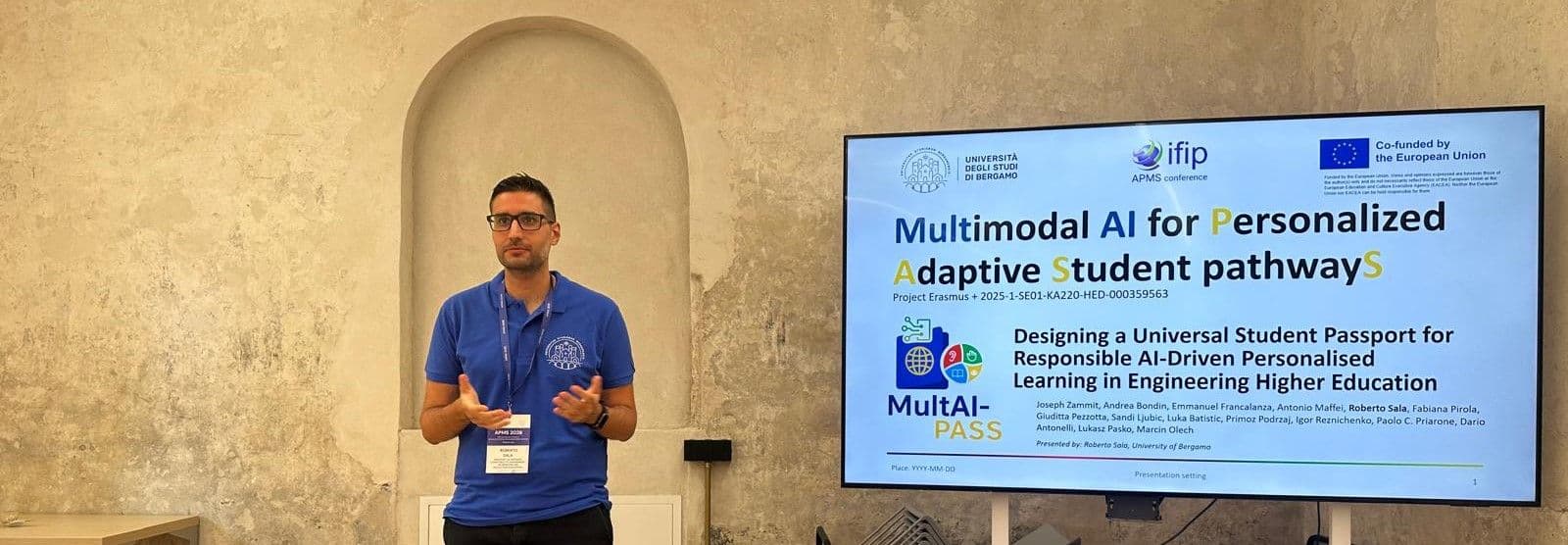
A paper developed within the Erasmus+ MultAI-PASS project was presented at APMS 2026 in Bergamo, Italy. Titled Designing a Universal Student Passport for Responsible AI-Driven Personalised Learning in Engineering Higher Education, it proposes a conceptual architecture for representing learners' preferences and support needs to inform responsible AI-supported learning.
The University of Malta, which leads WP3, coordinated the paper's preparation in collaboration with consortium co-authors from KTH Royal Institute of Technology, the University of Bergamo, the University of Rijeka, the University of Ljubljana, and Politecnico di Torino. Roberto Sala of the University of Bergamo presented the paper during a special session.
The proposed passport brings together learner preferences, their pedagogical interpretation, AI-informing functions, governance and control, and portability between learning environments. Its design draws on complementary perspectives from VARK, Felder–Silverman, and Kolb to support a more nuanced learner profile, rather than assigning students to fixed types.
The paper envisages students choosing whether and how to use a profile summary – for example, to communicate their preferences to an educator or to inform a prompt in an AI-supported learning tool. The passport is intended to support personalisation without directly connecting to AI platforms or automatically determining their responses. Transparency, student agency, educator oversight, and clear governance are built into the proposed design.
The architecture is conceptual and has not yet been empirically validated in teaching and learning settings. The paper establishes a design basis for further development and evaluation of the Universal Student Passport in engineering higher education.
https://doi.org/10.1007/978-3-032-38618-2_15